
Digital marketing business basics for flower shops and floral brands
Flower businesses depend on timing, trust, and visibility. A customer may need same-day birthday flowers, sympathy arrangements, wedding florals, event centrepieces, seasonal bouquets, or corporate floral subscriptions. A digital marketing business helps turn those moments of intent into measurable enquiries, online orders, phone calls, consultation bookings, and repeat customers.
For floral retailers, studios, growers, and delivery-focused brands, accountable marketing means knowing which campaigns actually bring useful demand. This flower-focused guide builds on the original discussion of digital marketing business basics for accountable growth, while applying the same measurement-first thinking to the unique buying patterns of the flower industry.
A florist’s marketing plan should not only ask, “How do we get more traffic?” It should ask, “Which traffic leads to bouquet orders, wedding consultations, sympathy calls, store visits, and repeat purchases?” When search visibility, paid ads, website design, content, social media, and tracking work together, a flower business can make better decisions before increasing spend.
Quick facts for floral marketing planning
Use this snapshot before comparing marketing channels or vendors.
- Core purpose: Digital marketing helps flower businesses turn search demand, seasonal interest, local visibility, and website visits into measurable customer actions.
- Main channels: Local SEO, Google Ads, product and service pages, online ordering pages, social media, email, and analytics usually work best as one connected system.
- Key metrics: Useful reporting focuses on online orders, phone calls, consultation requests, form submissions, conversion rate, cost per lead, and repeat purchase signals.
- Common risk: A floral campaign can look successful through impressions and clicks while failing to produce orders or qualified event enquiries.
- Practical sequence: Fix tracking first, improve important pages next, then scale the channels that bring qualified flower buyers.
Why flower businesses need accountable digital marketing
Flower purchases are often emotional, urgent, seasonal, or occasion-based. Someone searching for “same-day roses near me” is in a different mindset from someone researching wedding floral packages six months ahead. A strong digital marketing plan recognizes these differences and builds separate paths for each type of buyer.
Accountable growth starts with a clear conversion. For a flower shop, that conversion may be an online bouquet order, a phone call, a wedding consultation request, a subscription enquiry, a quote form, or a newsletter signup for seasonal promotions. Once those actions are defined, the business can ask better questions: Which search terms create orders? Which pages lead to calls? Which campaigns bring serious wedding enquiries?
This matters because flower marketing often involves many small decisions: which bouquet collections to feature, which delivery areas to promote, which holidays to prepare for, and which products deserve paid traffic. Without tracking, those decisions can become guesswork. With clean measurement, a floral business can see which activities support real customer behaviour.
For businesses that want outside support across SEO, PPC, web design, content, social media, and reporting, Zigma Internet Marketing outlines its broader service areas here: Digital Marketing Services.
The main digital marketing channels for floral growth
Not every channel serves the same purpose. A flower shop may need local SEO for ongoing discovery, paid ads for high-intent searches, web design for smoother ordering, and social media for visual trust. The strongest plan gives each channel a clear role.
Local SEO helps customers find flowers at the right moment
Search engine optimization helps a floral website appear for searches related to bouquets, delivery, weddings, sympathy flowers, events, and seasonal arrangements. For a local florist, SEO often includes service pages, delivery-area pages, product category pages, technical improvements, internal linking, and helpful content that answers buyer questions.
SEO is especially useful when a flower business wants lasting visibility beyond short-term promotions. A florist may build pages for “wedding flowers,” “same-day flower delivery,” “sympathy arrangements,” or “corporate flowers,” then support those pages with educational content about flower care, seasonal availability, and ordering timelines. For more detail on this type of work, see SEO Services.
PPC can support urgent and seasonal flower demand
Pay-per-click advertising can help a flower business appear quickly for high-intent searches. This may be useful for same-day delivery, holiday campaigns, wedding consultation campaigns, or specific product categories. The trade-off is direct spend, so tracking and landing page quality matter from the start.
A paid campaign should not send every visitor to the homepage. Someone searching for sympathy flowers should see a page that speaks to sympathy arrangements. Someone searching for wedding flowers should see event-focused information. Strong paid search management includes keyword control, negative keyword review, ad testing, conversion tracking, and landing page alignment. For search campaigns, Google Ads Management explains how structure, testing, and reporting fit together.
Website design affects orders, calls, and trust
A floral website is more than a digital brochure. It may need to support product browsing, online ordering, delivery details, event enquiries, consultation requests, and trust-building content. If visitors cannot find delivery information, understand bouquet options, or complete a form easily on mobile, strong traffic can still underperform.
Good website planning for a flower business should consider speed, mobile layout, product structure, calls to action, checkout flow, form placement, local SEO, and tracking. A redesign should protect existing search visibility while making it easier for customers to act. For technical and conversion-focused planning, Website Design & Development is a relevant starting point.
Content and social media support visual confidence
Flowers are highly visual, so social media and content can help customers feel confident before they order. Posts, galleries, arrangement guides, seasonal care tips, event inspiration, and behind-the-scenes floral design content can all support the buying path. However, social engagement should not be judged in isolation. The better question is whether content helps people take the next step: order, call, subscribe, visit, or request a consultation.
Tracking should be fixed before campaigns are scaled
Marketing without reliable tracking can mislead a flower business. A campaign may generate many clicks but few orders. A social post may create phone calls that are never connected to the source. A wedding page may attract visitors, but the business may not know whether those visitors become consultations.
Useful tracking for floral marketing may include analytics setup, event tracking, form tracking, phone call tracking where appropriate, order tracking, campaign naming standards, and dashboard reporting. The goal is not to make reporting complicated. The goal is to make it trustworthy enough to guide decisions.
A practical floral marketing dashboard should help answer questions such as:
- Which channels bring orders or qualified enquiries? This helps separate useful traffic from general browsing.
- Which bouquet, delivery, or event pages convert? Page-level reporting shows where content and layout need improvement.
- Which campaigns waste spend? Search term reviews and conversion data can reveal mismatches between buyer intent and ads.
- Which seasonal pushes deserve more attention? Reporting can help compare demand around holidays, events, and recurring floral needs.
- Which next action is most important? Good reporting should lead to a decision, not just a chart.
SEO and paid ads work better when they share flower buyer data
SEO and PPC are often managed separately, but flower businesses can benefit when both channels share insight. Paid search can reveal which queries, bouquet categories, or service messages attract action quickly. SEO can then use that insight to improve long-term pages and content.
The reverse is also true. Organic search data can show which flower-related topics attract steady interest. Those topics may guide ad groups, product collections, content updates, or landing page tests. A combined approach can be especially useful for florists balancing everyday orders with peak seasonal campaigns.
SEO versus PPC for flower businesses
A) SEO for ongoing floral visibility: SEO is a good fit when a florist wants long-term visibility for delivery, wedding, sympathy, event, and product-category searches.
- How it works: SEO improves page relevance, technical clarity, content depth, internal linking, and local search signals.
- Best fit: It fits flower businesses with stable services, defined delivery areas, and patience for gradual search growth.
- Example: A florist may create dedicated pages for wedding flowers, sympathy flowers, and local flower delivery, then support those pages with helpful buying guides.
B) PPC for faster testing and seasonal pushes: PPC can help test messaging and capture urgent search demand more quickly.
- How it works: Paid campaigns target search queries or audiences, then use conversion data to refine bids, ads, exclusions, and landing pages.
- Best fit: It fits holiday promotions, new delivery areas, high-intent searches, and campaigns where timing matters.
- Example: A florist may test ad copy for same-day delivery before using the strongest message on a permanent landing page.
C) Combined SEO and PPC for shared learning: A blended plan uses paid ads for faster feedback and SEO for durable visibility.
- How it works: Paid keyword data informs SEO content, while organic visibility can reduce reliance on paid clicks for recurring searches.
- Best fit: It fits flower businesses that need near-term customer enquiries while building a stronger search footprint.
- Example: A high-performing paid search term for event florals may become the basis for a dedicated service page and supporting blog content.
How flower businesses should evaluate a marketing partner
Choosing a digital marketing partner is easier when the decision is based on process rather than broad promises. A strong agency should explain how it will define conversions, track customer actions, diagnose website issues, and connect campaign work to business outcomes.
Flower businesses should ask practical questions before signing on:
- How will conversions be defined? The agency should distinguish between online orders, phone calls, event enquiries, newsletter signups, and other actions.
- How will reporting separate activity from value? Clicks and impressions matter, but they should not be treated as the final measure of success.
- How will local search be handled? A florist often needs visibility by city, neighbourhood, delivery area, and service type.
- How will paid ads and SEO share data? Keyword and conversion insights can reduce waste across both channels.
- How will the website support campaigns? Marketing can stall if mobile usability, page speed, product structure, forms, or checkout flow are ignored.
- How will seasonal campaigns be planned? Flower marketing often needs lead time for holidays, weddings, and event seasons.
A full-service structure can be useful when a problem crosses disciplines. For example, a paid campaign may appear weak when the real issue is a slow landing page, unclear delivery information, or incomplete tracking.
What affects return from floral marketing campaigns
Return from digital marketing is shaped by more than ad budget or posting frequency. For flower businesses, results depend on the match between buyer intent, product or service offering, landing page clarity, trust signals, delivery details, follow-up process, and measurement quality.
Several factors can directly affect campaign efficiency:
- Intent match: A same-day delivery search is different from early wedding research or flower-care browsing.
- Landing page relevance: Visitors should land on a page that matches the arrangement, occasion, service, or location they searched for.
- Delivery and service clarity: Customers often need to understand delivery areas, timing, pickup options, consultation steps, and ordering instructions.
- Mobile usability: Many flower buyers browse and order on mobile devices, so forms, buttons, galleries, and checkout steps should be easy to use.
- Trust signals: Photos, service descriptions, policies, reviews where available, and clear contact options can help visitors feel confident.
- Tracking quality: Inaccurate tracking can send budget toward clicks that do not produce meaningful orders or enquiries.
- Follow-up consistency: Event and wedding enquiries can lose value if they are not answered with enough context and speed.
The best campaigns are treated as systems. Ads, SEO, content, landing pages, tracking, and customer follow-up should be reviewed together instead of being managed as disconnected tasks.
A practical checklist before increasing floral marketing spend
Before a flower business raises ad budgets or publishes more content, the foundation should be checked. More traffic can amplify existing problems if the website, tracking, or offer is unclear.
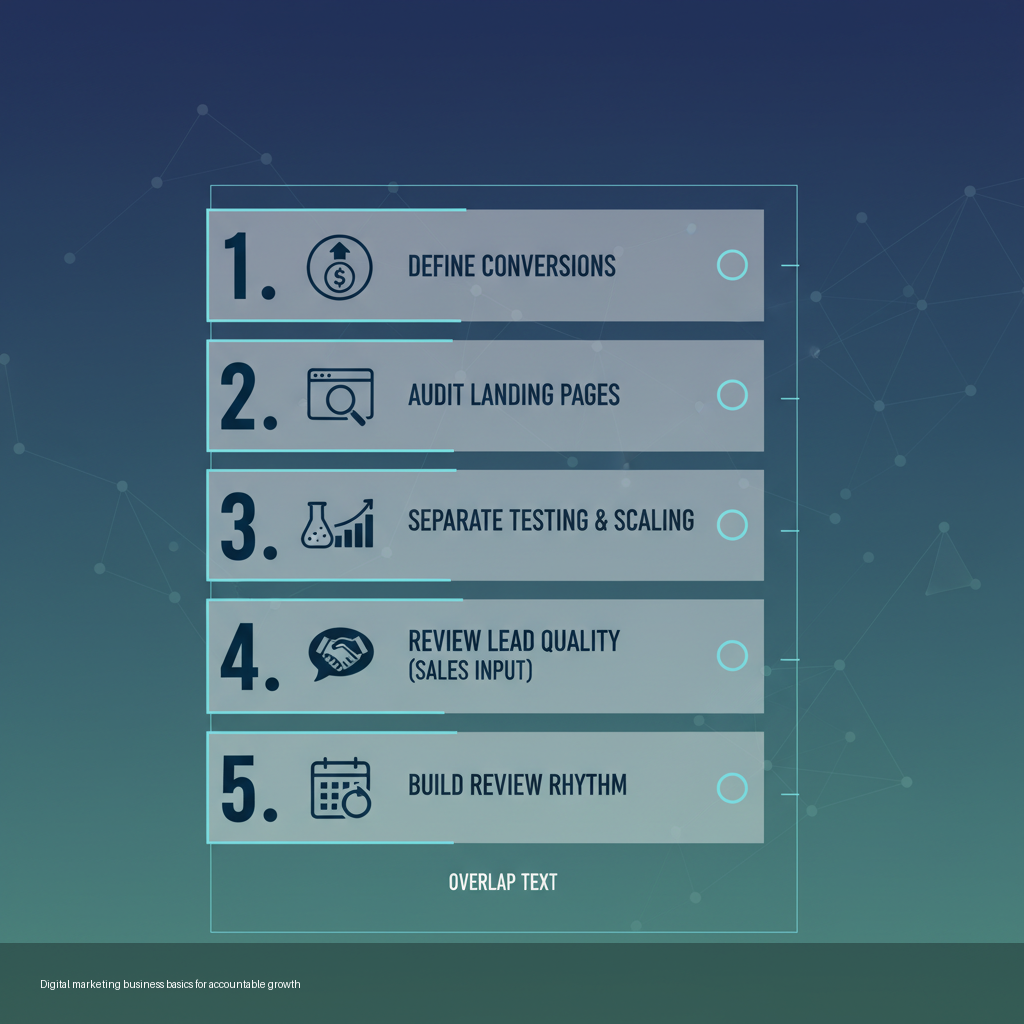
Step 1: Define the conversion
Decide which customer actions matter most. Online orders, quote requests, wedding consultations, calls, and newsletter signups should not all be treated the same.
Watch for: Reports that celebrate traffic without showing orders or qualified enquiries.
Useful check: Confirm that forms, calls, and online order actions are tracked clearly.
Step 2: Review the most important landing pages
Look at the pages receiving paid and organic traffic. A flower delivery page, wedding florals page, or sympathy arrangements page should answer the buyer’s main questions quickly.
Watch for: Vague headlines, hidden contact options, unclear delivery information, weak mobile layouts, or slow-loading galleries.
Useful check: Compare page performance by source, device, and conversion action.
Step 3: Separate testing from scaling
Test messages, pages, or audiences before expanding spend. If too many changes happen at once, it becomes difficult to know what caused performance to shift.
Watch for: Changing ads, keywords, landing pages, and budgets at the same time without a testing plan.
Useful check: Keep a simple change log and review performance after enough data has collected.
Step 4: Compare marketing data with customer feedback
Marketing reports should be checked against real sales or enquiry quality. A campaign that generates many low-fit enquiries may need better targeting, clearer copy, or stronger qualification.
Watch for: High form volume but few serious orders, consultations, or repeat customers.
Useful check: Tag enquiries by source, service interest, qualification status, and outcome where possible.
Step 5: Build a seasonal review rhythm
Flower marketing often follows seasonal and occasion-based patterns. A regular review cycle helps the business prepare content, ads, website updates, and reporting before demand peaks.
Watch for: Last-minute campaigns without tracking or landing page preparation.
Useful check: End each review with a short action list, an owner, and a follow-up date.
Signs your floral marketing needs a reset
A marketing reset is not a failure. It often means the flower business has outgrown an older website structure, tracking setup, content plan, or campaign approach. The warning signs may appear before the dashboard makes them obvious.
Common signs include rising ad spend without better enquiry quality, traffic growth without more orders, unclear reporting between platforms, outdated product or service pages, and confusion about which campaigns are actually working. Another sign is a mismatch between what the business currently sells and what its website still promotes.
Short-term fixes versus system fixes
A short-term fix may pause a weak ad group or update a headline.
A system fix may rebuild tracking, revise landing pages, improve local SEO, and connect enquiry quality back to campaign source.
Short-term fixes can help, but system fixes usually make performance easier to understand.
The stronger path is usually to simplify first. Clean up tracking, define meaningful customer actions, repair high-impact website issues, and then decide which channels deserve more investment.
Get clearer marketing direction before your next floral campaign
If your flower business is getting website traffic but not enough useful orders, calls, or consultation requests, a structured review can reveal where the gaps are. The right review should look at channel mix, tracking, landing pages, local SEO, paid search, and the customer journey from first click to final enquiry.
For help reviewing your current setup and growth priorities, Book a Free Strategy Call.
FAQs about digital marketing business strategy for flower shops
How can a florist know whether marketing is being measured properly?
Marketing is being measured properly when online orders, phone calls, forms, consultation requests, and other meaningful actions can be traced back to the correct channel and campaign. Reports should separate general activity from customer actions that matter to the business.
Should a flower business start with SEO or paid ads?
The better first step depends on the business goal. Paid ads can test demand and messaging quickly, while SEO builds longer-term visibility for flower delivery, weddings, sympathy arrangements, and other recurring searches. Many florists benefit from using both together.
Why is the website so important for floral marketing?
The website affects whether visitors can understand services, browse arrangements, confirm delivery details, request consultations, and place orders. Strong traffic can still underperform if the site is slow, unclear, difficult to use on mobile, or missing conversion tracking.
What should florists track during seasonal campaigns?
Florists should track actions such as online orders, calls, product-page performance, delivery-area demand, form submissions, and campaign source. Seasonal campaigns should be reviewed by business value, not only by impressions or clicks.
How should a flower business compare digital marketing agencies?
Compare agencies by how clearly they define conversions, explain reporting, connect SEO and paid media, handle website issues, and plan around the customer journey. A strong partner should make trade-offs visible and connect recommendations to measurable outcomes.