
Why flower businesses need marketing clarity before spending more
For florists, flower delivery companies, wedding floral designers, garden centres, and floral subscription brands, marketing can become busy very quickly. Seasonal campaigns, local SEO, social media posts, Google Ads, product pages, delivery-zone updates, and event enquiries all compete for attention. A digital marketing consultant helps connect those activities to practical business outcomes such as more qualified bouquet orders, wedding consultations, sympathy flower requests, corporate accounts, or repeat customers.
The core value of consulting is not simply “doing more marketing.” It is understanding which marketing work is actually helping the flower business grow. For a broader explanation of this role, Zigma’s original guide on digital marketing consultant guidance for smarter growth explains how consultants separate activity from traction and help businesses make better budget decisions.
That distinction matters in the floral industry because demand changes by occasion, season, location, and customer intent. Someone searching for same-day flower delivery may need a fast ordering path, while a wedding client may need galleries, trust signals, and a consultation form. A good consultant reviews how SEO, paid search, web design, content, analytics, and conversion work support those different customer journeys. If a flower business needs both strategy and execution, Zigma Internet Marketing offers Digital Marketing Services built around tracking, reporting, and continual improvement.
How a digital marketing consultant helps a floral brand turn attention into orders
A flower website can receive traffic without generating enough valuable enquiries or purchases. Visitors may browse arrangements, check delivery information, look at wedding portfolios, or compare sympathy designs without taking the next step. A digital marketing consultant reviews whether the right visitors are arriving, whether they understand the offer, and whether the website makes ordering or enquiring simple.
The work often begins with an audit. For a flower business, that may include reviewing local search visibility, product category pages, delivery-area pages, wedding and event content, Google Ads campaigns, checkout steps, analytics setup, mobile usability, and call or form tracking. The goal is to identify which problems are technical, which are strategic, and which are caused by unclear measurement.
Several marketing terms matter in this process. SEO, or search engine optimization, improves organic visibility in search results through technical health, useful content, relevance, and authority signals. PPC, or pay per click advertising, places paid ads in platforms such as Google Ads and charges when someone clicks. CRO, or conversion rate optimization, improves the percentage of visitors who complete an action such as ordering flowers, calling the shop, requesting a wedding quote, or joining a subscription list. GA4, or Google Analytics 4, helps measure user behaviour and campaign performance.
These channels affect one another. Weak tracking can make a profitable flower delivery campaign look ineffective. A slow mobile checkout can reduce the value of both SEO and PPC. A wedding flowers page without clear next steps can waste strong traffic from search or social media. Consulting helps reveal these connections so decisions are based on evidence rather than habit.
Signs a flower business may need outside marketing diagnosis
Outside guidance is useful when marketing feels active but unclear. Many floral businesses post regularly on Instagram, update seasonal products, run ads near major holidays, and write occasional blog content, yet still struggle to understand what is producing real business value.
Common warning signs include:
- Website visits increase but orders do not: The issue may be product page clarity, delivery information, pricing presentation, checkout friction, or mismatched traffic intent.
- Wedding enquiries are low despite strong portfolio images: The page may need stronger service details, location targeting, trust signals, form improvements, or clearer calls to action.
- Holiday ad spend is hard to explain: Search terms, negative keywords, bidding, landing page relevance, and conversion tracking may need review before the next seasonal campaign.
- Local SEO traffic is flat: The website may lack location pages, internal linking, optimized service pages, or content that matches customer search intent.
- Reports show numbers but not decisions: Dashboards should help explain which channels create orders, calls, enquiries, and higher-value customer actions where data is available.
The better question is not only “Should we post more flowers online?” A stronger question is: “Which constraint is stopping the right customer from ordering, calling, or enquiring?” That moves the conversation from content volume to business diagnosis.
Consultant, agency, or freelancer: choosing support for floral marketing
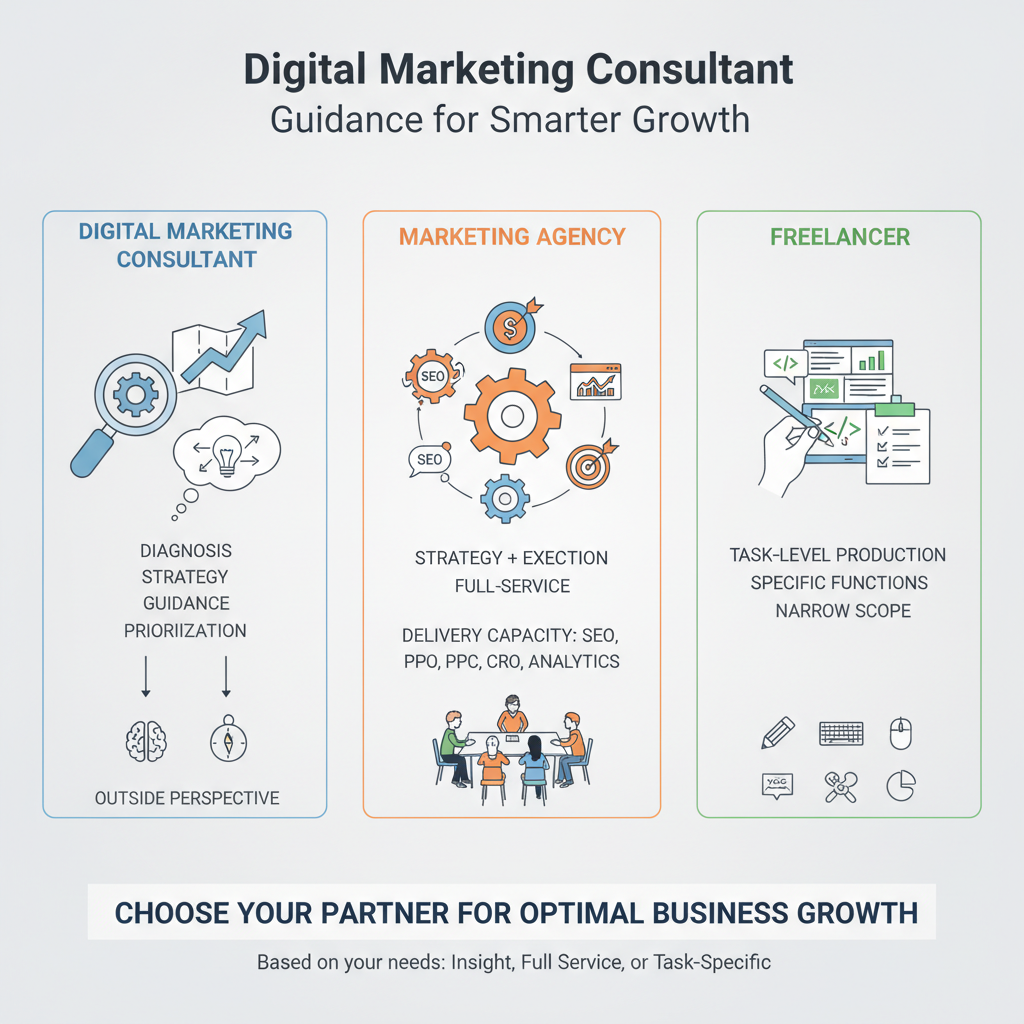
Different marketing partners solve different problems. A consultant is often strongest at diagnosis, planning, prioritization, and performance review. An agency usually provides strategy and hands-on execution across multiple channels. A freelancer may be useful for a specific task such as floral photography editing, website updates, copywriting, or ad creative.
Choosing the right marketing support structure
A) Consultant: A consultant reviews your current marketing system and recommends what to fix, pause, improve, or scale.
- How it works: The consultant audits performance, identifies gaps, builds a priority plan, and helps decision makers understand trade-offs.
- Fit: This works well for a florist or floral brand that already has staff or vendors but needs sharper direction.
- Example: A flower shop running ads and posting regularly may hire a consultant to find out why traffic is steady but online orders remain weak.
B) Agency: An agency handles strategy and execution across several areas, such as SEO, PPC, landing pages, web development, analytics, content, and social media.
- How it works: The agency creates a plan, implements channel work, reports on performance, and adjusts campaigns based on data.
- Fit: This structure fits a flower business that needs delivery capacity along with strategic guidance.
- Example: A floral company may work with Zigma Internet Marketing for SEO Services, paid search, landing pages, and analytics under one coordinated plan.
C) Freelancer: A freelancer usually supports a defined function when the strategy is already clear.
- How it works: The freelancer completes assigned work such as writing product descriptions, designing banners, editing pages, or creating ad visuals.
- Fit: This role fits a flower business with strong internal direction and a clear brief.
- Example: A florist may hire a freelance designer to create Mother’s Day campaign graphics after the offer, audience, and landing page plan have already been defined.
The trade-off is straightforward. Consulting gives clarity. Agency work gives delivery. Freelance support gives task-level production. Many flower businesses need a mix, especially during seasonal campaigns when strategy and implementation must move together.
A practical checklist before hiring a marketing consultant for a flower business
Before speaking with a consultant, gather the information that will make the review useful. A strong advisor can work with imperfect data, but unclear goals and scattered access make diagnosis slower. Preparation also helps you judge whether the advice is practical or vague.
Step 1: Define the business outcome
Write down the outcome you want marketing to support. For a flower business, that may be more online bouquet orders, more same-day delivery requests, more wedding consultations, more corporate floral accounts, or clearer reporting on seasonal campaigns.
Useful metric: Choose one primary metric such as completed purchases, qualified enquiries, phone calls, consultation bookings, or subscription sign-ups.
Common mistake: Asking for more traffic without defining what the right visitor should do.
Example: A wedding florist may decide that the target outcome is more qualified consultation requests from couples in specific service areas rather than more total website visits.
Step 2: Check whether tracking is trustworthy
Review whether calls, checkout completions, contact forms, quote requests, chat leads, and key events are measured correctly. Poor tracking can lead to the wrong conclusion about which campaigns deserve budget.
Useful metric: Compare website conversions with order records, call logs, or customer relationship management data where possible.
Common mistake: Treating every form submission as equal when some are spam, vendor outreach, or poor-fit enquiries.
Example: A campaign for funeral flowers may appear to generate leads, but a closer review may show that some tracked actions are low-intent page interactions rather than real enquiries.
Step 3: Separate channel problems from website problems
A campaign may bring the right customer to the wrong page. Before blaming SEO, Google Ads, or social media, review page speed, delivery details, product descriptions, mobile layout, trust cues, forms, and calls to action.
Useful metric: Look at conversion rate by landing page, not only by channel.
Common mistake: Increasing ad spend before fixing a product or service page that does not answer buyer questions.
Example: If someone clicks an ad for “same-day roses” but lands on a generic homepage, conversions may suffer even when targeting is accurate.
Step 4: Review how campaign decisions are made
Marketing improves faster when decisions follow a consistent cycle: test, measure, review, adjust. Random changes make performance difficult to interpret, especially around major floral dates and seasonal demand.
Useful metric: Track changes against dates, campaigns, page updates, product availability, and budget shifts.
Common mistake: Changing ads, product categories, offers, and tracking all at once, then being unable to identify what caused the result.
Example: A Valentine’s Day landing page test should compare a clear variation against the current page while keeping the traffic source stable enough for interpretation.
Step 5: Ask how recommendations will be prioritized
A useful plan ranks work by likely effect, effort, urgency, and dependency. Technical fixes, local SEO updates, paid search improvements, product page changes, and conversion tasks should not be treated as equal.
Useful metric: Assign each task an expected business impact and implementation effort rating.
Common mistake: Starting with visible design changes while tracking, search intent, or checkout problems remain unresolved.
Example: Fixing broken purchase tracking may come before rewriting ads because accurate measurement is needed to judge future campaign changes.
How to judge SEO, PPC, CRO, and reporting quality for floral marketing
Marketing advice should become more specific as the consultant reviews your data. Broad comments may be acceptable in an early conversation, but a real assessment should eventually name the page, keyword theme, campaign, audience, event, or reporting gap being discussed.
SEO quality signals
Strong SEO guidance connects search intent, technical health, content structure, internal linking, and authority signals. For flower businesses, SEO may involve local flower delivery pages, wedding flower service pages, sympathy arrangement content, seasonal collection pages, and helpful floral care articles. If a consultant recommends new content, they should explain which search theme it supports and how success will be evaluated.
PPC quality signals
Paid search advice should address search terms, negative keywords, match types, bidding, budget allocation, conversion tracking, and landing page relevance. A healthy Google Ads (PPC) account is not judged by clicks alone. It is judged by the quality and cost efficiency of the orders, calls, or enquiries those clicks produce.
CRO quality signals
Conversion work should focus on user behaviour, page clarity, trust cues, friction, and message match. A consultant may recommend clearer product details, more visible delivery information, stronger wedding enquiry forms, better mobile layouts, improved checkout flow, or clearer seasonal offers. The goal is to make the next step easier for qualified visitors, not to pressure every visitor into buying immediately.
Reporting quality signals
Reporting should help a flower business owner or marketing manager act. Useful dashboards connect spend, traffic, orders, enquiries, lead quality, and sales feedback where data access allows. If reports show only impressions, clicks, sessions, and rankings, they may be missing the business context needed for budget decisions.
What a healthy consulting engagement should produce
A useful consulting engagement should leave a flower business with clearer decisions, not just a longer task list. The final output may be an audit, roadmap, channel plan, measurement plan, dashboard review, landing page brief, or campaign improvement plan. The format can vary, but the substance should reduce uncertainty.
Look for these concrete deliverables:
- A prioritized roadmap: The plan should rank work by impact, effort, and dependencies so your team knows what to address first.
- A measurement framework: The consultant should define which events, conversions, and business metrics will be used to judge performance.
- Channel-specific recommendations: SEO, PPC, content, social media, web, and analytics advice should be tied to the role each channel plays in the floral customer journey.
- Implementation guidance: Recommendations should be clear enough for a developer, marketer, designer, florist, or ad specialist to act on.
- A review cadence: Marketing decisions should be revisited after enough data has been collected to make a fair comparison.
A consultant does not remove all uncertainty from marketing. The real value is sharper thinking, cleaner measurement, and fewer decisions made from incomplete signals.
A careful next step for flower businesses seeking outside perspective
If your flower shop, floral studio, or delivery brand has marketing reports that are difficult to interpret, a structured review can help clarify what deserves attention first. SEO, PPC, landing pages, product pages, local search, and analytics should work together rather than operate as disconnected tasks.
Zigma Internet Marketing brings Google Partner-certified expertise, full-service execution across SEO, paid search, web, content, and social, and reporting focused on calls, forms, sales, and acquisition efficiency. For a grounded review of your current marketing setup, you can ask Zigma for a practical marketing review. Bring your goals, available reports, website access, ad account access if available, and the questions your team has been debating.
FAQs About Digital Marketing Consultants for Flower Businesses
How do I know whether my flower business needs a digital marketing consultant or an agency?
Choose a consultant when you need diagnosis, planning, or an outside review of existing marketing. Choose an agency when you also need hands-on execution across SEO, PPC, web, content, analytics, or social channels. Some flower businesses use both: consulting for direction and an agency for implementation.
What should a florist prepare before speaking with a digital marketing consultant?
Prepare your main business goal, current website, analytics access, ad account access if available, recent reports, customer types, delivery areas, seasonal priorities, and sales feedback. Real performance signals are more useful than polished presentations.
Can a consultant help with seasonal flower campaigns?
Yes. A consultant can review past seasonal performance, campaign timing, landing pages, keyword intent, ad structure, product availability, and tracking. The goal is to help the next campaign run with clearer priorities and better measurement.
Can a consultant review Google Ads without managing the account?
Yes. A consultant can audit search terms, conversion tracking, landing pages, bidding structure, campaign settings, and lead or order quality without taking over management. The review should identify wasted spend patterns, measurement gaps, and practical changes your internal team or agency can apply.
What makes marketing reporting useful for a flower shop?
Useful reporting connects marketing activity to decisions. A strong report shows which channels create orders, calls, wedding enquiries, delivery requests, and repeat-customer actions. Detail is valuable only when it explains what should happen next.